
Executive Summary
Expanding Salesforce Value Through a Research-Led Shaklee Connect Redesign
Company
Salesforce (client: Shaklee)
Timeline
4-month first phase
Project
Mobile-First CRM Redesign
My Role
Director, Experience Design
The Problem
- A previous Salesforce rollout, sold and built by an outside reseller, struggled with adoption among everyday distributors.
- Salesforce followed that reseller with a different suite of enterprise software and advisory services to recover the account. My team was brought in to implement it.
- Our research found the new suite carried the same enterprise CRM assumptions, rather than matching how independent small business owners ran their Shaklee businesses.
Outcome
- Rebuilt Shaklee Connect around mobile-first, relationship-based work and short bursts of productivity.
- Increased distributor engagement by 40% within three months of launch: time in the product, and how often distributors signed in.
- Over the following two years the business the tool supported grew by double digits: product sold, new distributors added, and networks grown. The Salesforce contract renewed and grew. The redesign was one input among several, and I cannot isolate its share.
My Role
- Director, Experience Design, leading the design work on a Salesforce advisory team.
- Led two designers and one researcher through research, synthesis, design strategy, and delivery.
- Took the research to Salesforce’s sales leadership, where it changed what Shaklee was paying for.
Detailed Case Study
Context and Challenge
Why This Problem Mattered
What was not working
- The prior implementation was technically delivered but did not fit distributor workflows.
- Everyday distributors found it difficult to use and disconnected from the practical work of running their businesses.
Why it struggled
- The experience translated enterprise CRM and marketing assumptions into tools for independent small business owners.
- The initial implementation did not deeply involve the distributors who were expected to use the product every day.
Business risk
- Distributors were not using it, and the account was at risk.
- Salesforce’s direct relationship with Shaklee needed rebuilding after the third-party implementation struggled.
Constraints and Complexities
Rebuilding Trust
- Needed to re-engage skeptical stakeholders after a struggling rollout.
- Had to prove that design-led advisory work could produce a different result.
Unique Audience
- Distributors operated as independent small business owners selling to customers, friends, and family, and supporting the distributors they had recruited (their downline).
- Many ran the business in spare moments, often from a phone.
Platform and Data Realities
- The broader renewal included Salesforce Platform, Salesforce Marketing Cloud, Einstein Analytics, and advisory services.
- Shaklee’s data was too messy and incomplete to fully benefit from advanced analytics without additional maturity work.
My Role and Decision Ownership
I led the design work on a Salesforce advisory team as Director, Experience Design, with two designers and one researcher. My job was to reset the engagement around research, turn what we saw in the field into product strategy, and put the findings in front of the people who could change the account plan.
Engagement Reset
- Reframed the work from implementation recovery to user-centered product and account strategy.
- Established distributor research and stakeholder interviews as the foundation for strategic decisions.
Strategic Facilitator
- Brought the research to Salesforce’s sales leadership, which changed what Shaklee was paying for.
Delivery Owner
- Directed research synthesis, design strategy, mobile product design, and executive storytelling.
What the Research Changed About the Contract
Shaklee had just renewed a contract that included Einstein Analytics. The research showed the data could not support it yet: distributors kept most customer information offline, and what existed was incomplete. Working with the Salesforce advisory and account teams, we recommended walking back the existing agreement and redirecting investment toward the work that had to come first: cleaning up the data and building the maturity needed for analytics to become useful. Salesforce aligned around the long-term customer relationship over the short-term value of the agreement, which helped rebuild trust and create a better path to platform value.
Research
Problem Definition
Target Users
- Independent distributors managing customers, personal networks, and the distributors they had recruited.
- Shaklee executives and distributor leadership looking for engagement, growth, and a return on the platform.
Core Experience Gaps
- CRM workflows prioritized records, transactions, and enterprise marketing over relationships.
- Existing data and reporting could not reliably support the level of analytics ambition in the renewal.
Required Shift
- Move from enterprise tooling to a phone-first tool for keeping relationships going.
- Use Salesforce capability without making distributors deal with it, so everyday business actions stay simple.
User Interviews
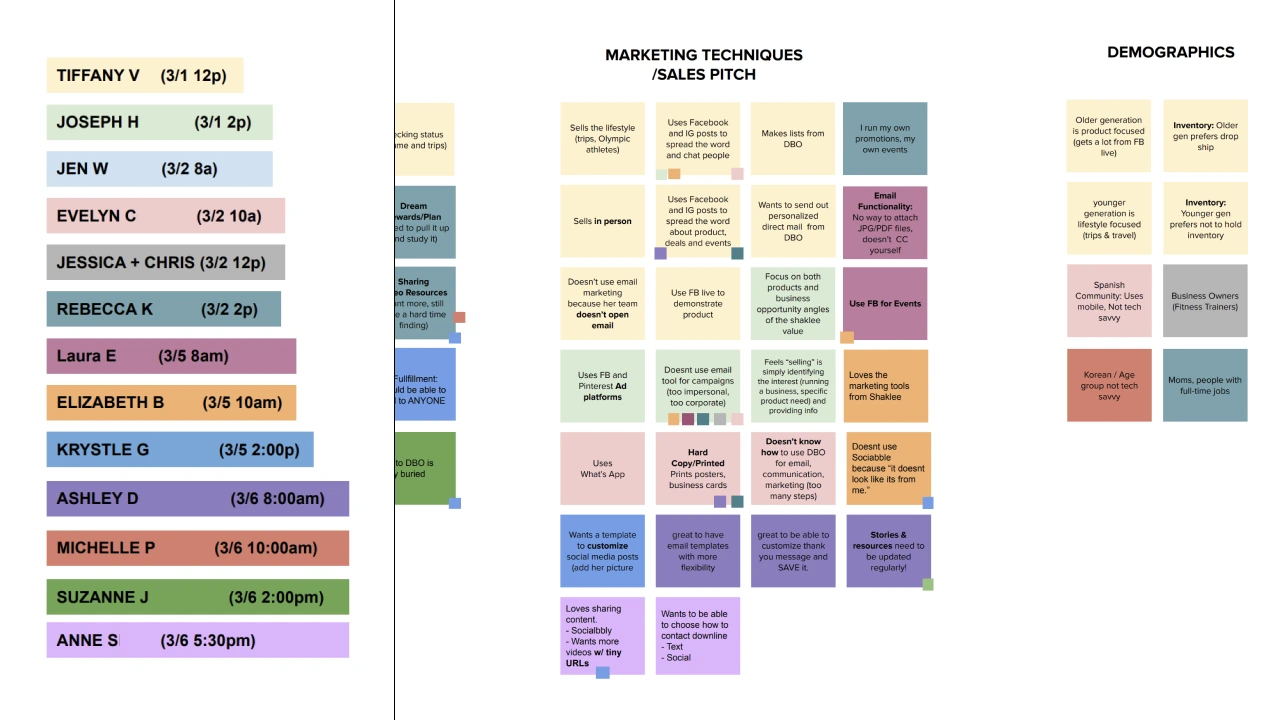
Phase one included 27 distributor interviews, 9 stakeholder interviews, and 250 survey responses. We spoke with Shaklee executives, distributor leadership, Salesforce partners, and the people using the product in the field.
Interview Synthesis
Each color is one interviewee, and each card is one sentiment they offered. We grouped the sentiments by affinity.
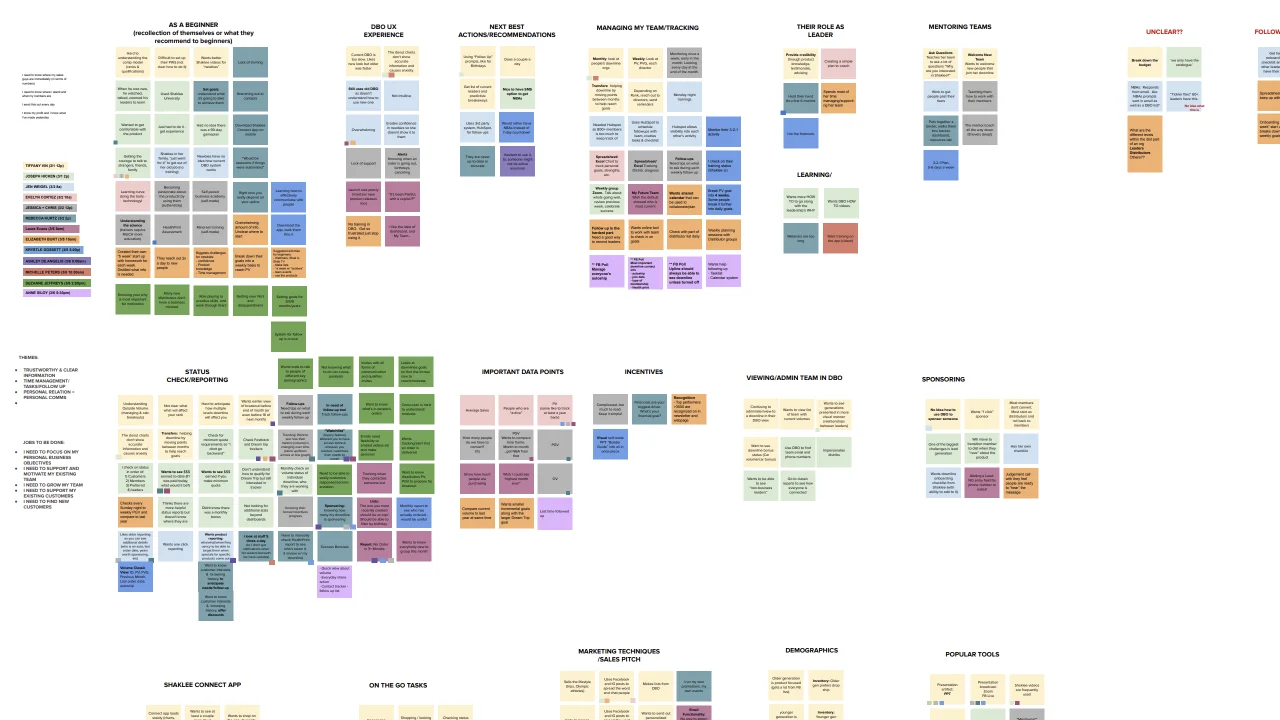
High-Level Interview Synthesis Map
Key Findings
Relationships Are the Business
- Distributors built revenue through trust networks, personal stories, and ongoing relationship maintenance.
- Communication needed to match the formality, context, and dynamics of each relationship.
Spare Moments Matter
- Many distributors ran the business in short mobile sessions around other responsibilities.
- The phone was a presentation tool, content library, contact list, and point of action.
Data Needed Context and Trust
- Shaklee had ecommerce attribution data, but distributor-managed information was incomplete and often kept offline.
- Advanced analytics required stronger data foundations before recommendations could be trusted or useful.
Design
Design Strategy
Human Before System
- Redesign around distributor behavior, not CRM structure.
- Support personal follow-up, encouragement, and relationship-building.
Mobile as Primary Workspace
- Optimize for quick daily tasks, on-the-go decisions, and field conversations.
- Make common actions possible in the small time windows distributors had.
Progressive Platform Value
- Put Salesforce Marketing Cloud, Platform, and analytics power behind simple mobile flows.
- Reveal advanced capabilities gradually for higher-capability business owners and leaders.
Solution Overview
Experience Redesign
- Rebuilt Shaklee Connect around everyday tasks: follow-up, recognition, goals, reminders, and personal outreach.
- Prioritized context, communication, and action over broad dashboard complexity.
Workflow Simplification
- Turned the seven research themes into shipped design features.
- Reduced the visible complexity of Salesforce without losing the tracking and reporting Shaklee relied on.
Strategic Deliverables
- Mobile product direction, user-validated prototypes, and executive artifacts.
- License and advisory recommendations that helped Shaklee mature toward deeper data and analytics capability.
Mobile Design
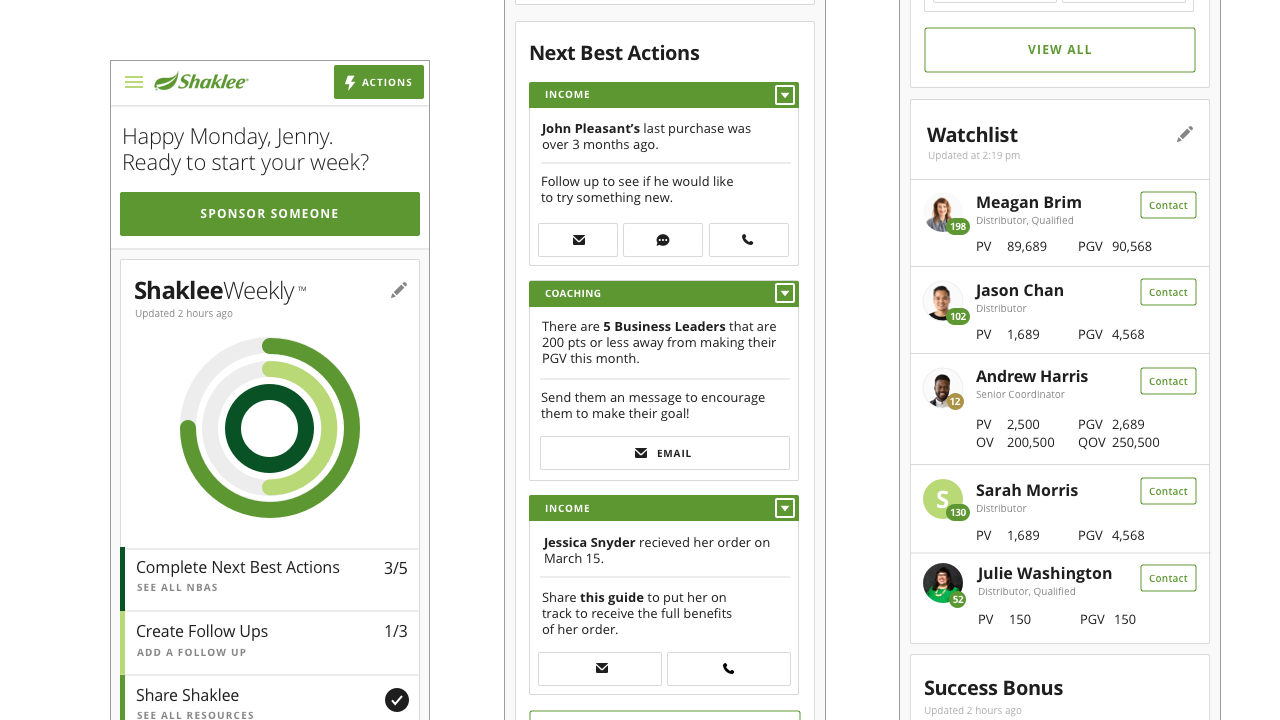
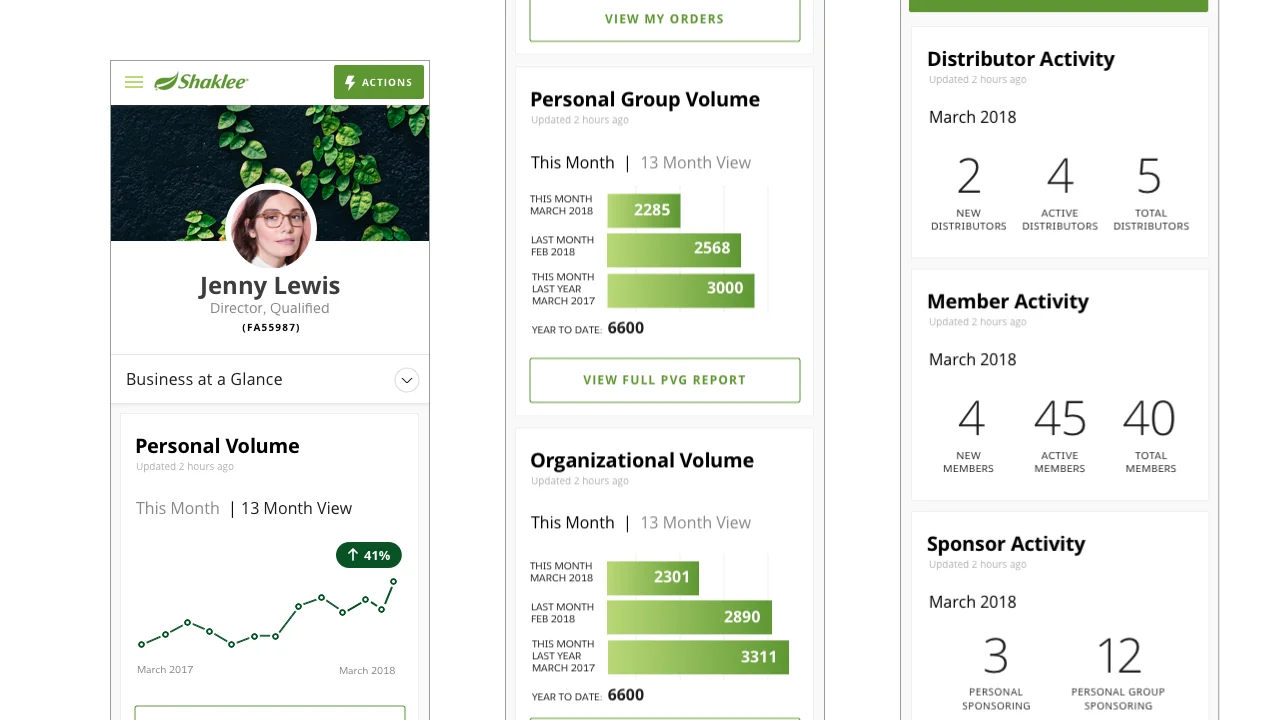
Designed mobile-first rather than mobile-adapted: a custom implementation of Salesforce capabilities that made everyday distributor work feel simple, personal, and fast while keeping enterprise tracking and reporting behind the scenes.
Dashboard
Tasks, follow-ups, and priority actions tuned for short moments between other responsibilities.
Business at a Glance
A clearer view of business health beyond the primary KPIs distributors already tracked.
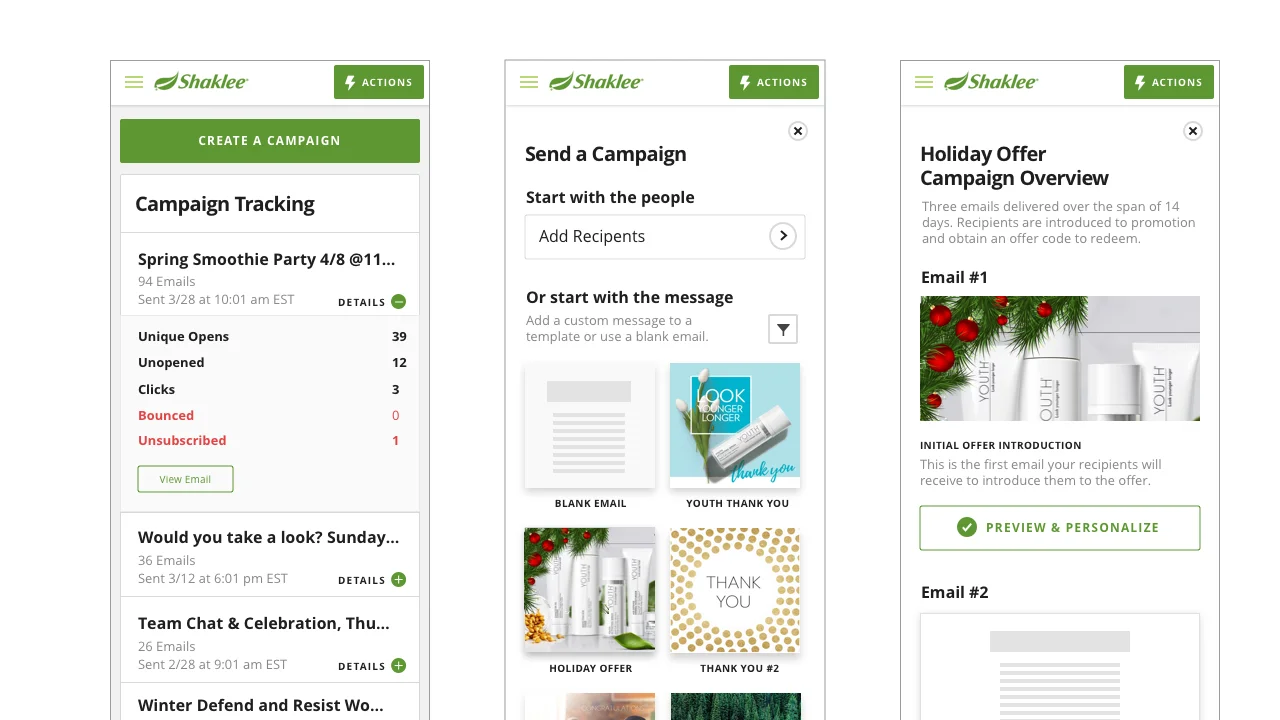
Marketing Campaigns
Outreach that feels personal, built for the phone, with opens and clicks tracked for every campaign.
Impact
5 of 5
Client Satisfaction
Formal survey, on an account that had been at risk
+40%
Distributor Engagement
Time in the product and sign-in frequency, three months after launch
“This has been our most successful consultant project.”
Shaklee’s chief executive, at the close of the first phase