Executive Summary
Idea Dash: 50% Faster Product Starts, 40% Increase in New Features That Met or Exceeded Goals
Company
Salesforce
Timeline
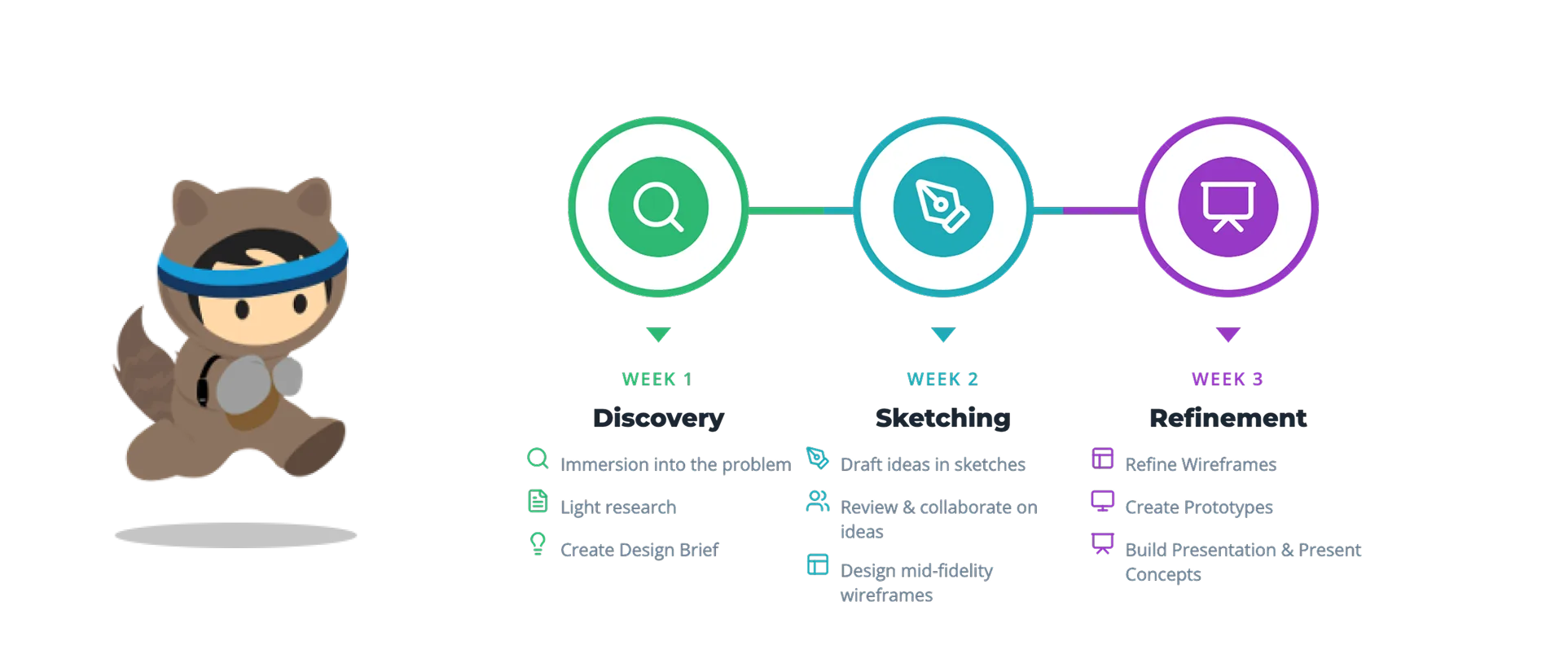
Two 3-week dashes
Project
Process Improvement
My Role
Creative Lead
& Facilitator
The Problem
- Executive product ideas lacked fast, credible evaluation
- Ideas stalled in committee or moved forward without shared rationale
Outcome
- 50% faster from leadership approval to the start of product development
- 40% increase in new features that met or exceeded goals
- Concept was approved and funded by Sales Cloud leadership, leading to Pipeline Inspection, which influenced how Sales Cloud presented records
My Role
- Architect and advocate of the Idea Dash design process
- Lead facilitator and designer for early executive-level engagements
- Advisor for Idea Dashes across Sales, Service, and Commerce Clouds
Detailed Case Study
Context and Challenge
Why This Problem Mattered
- Ideas surfaced through executive intuition, not evidence
- Early evaluation lacked ownership and momentum
- Committee-driven discussion delayed decisions
- Unilateral executive calls left teams unclear on rationale
- High downstream cost of false positives
- Strategic lag compared to competitors moving faster
Constraints and Complexities
- Needed to match executive decision cadence
- Could not slow momentum
- Had to earn trust from Product, Engineering, and Design
- Outputs needed experiential fidelity, not abstract strategy
- No dedicated team for early exploration
- Limited executive time and attention
My Role and Decision Ownership
I was the architect of this process and also its practitioner. On the sprint I was the lead designer and researcher, paired with one other designer, and as project lead I worked with advisory product management and engineering counterparts.
I was the senior half of it, and I used each dash to develop the other designer. They presented to the GM and the executive advisors at each touchpoint instead of watching me do it, and they built the rapid conceptual prototypes that carried each review. That meant learning to frame an ambiguous problem for executives, defend a concept in the room, and decide what a prototype had to prove before building it.
- Created Idea Dash independently within Design
- Presented and secured GM endorsement for adoption
- Led the first 3–4 Idea Dashes as an IC and player-coach
- Facilitated executive workshops and hands-on design exploration
- Advised subsequent Idea Dashes after process validation
- Expanded usage across Sales, Service, and Commerce Clouds
The Idea Dash Defined
Small, Design-Led Team
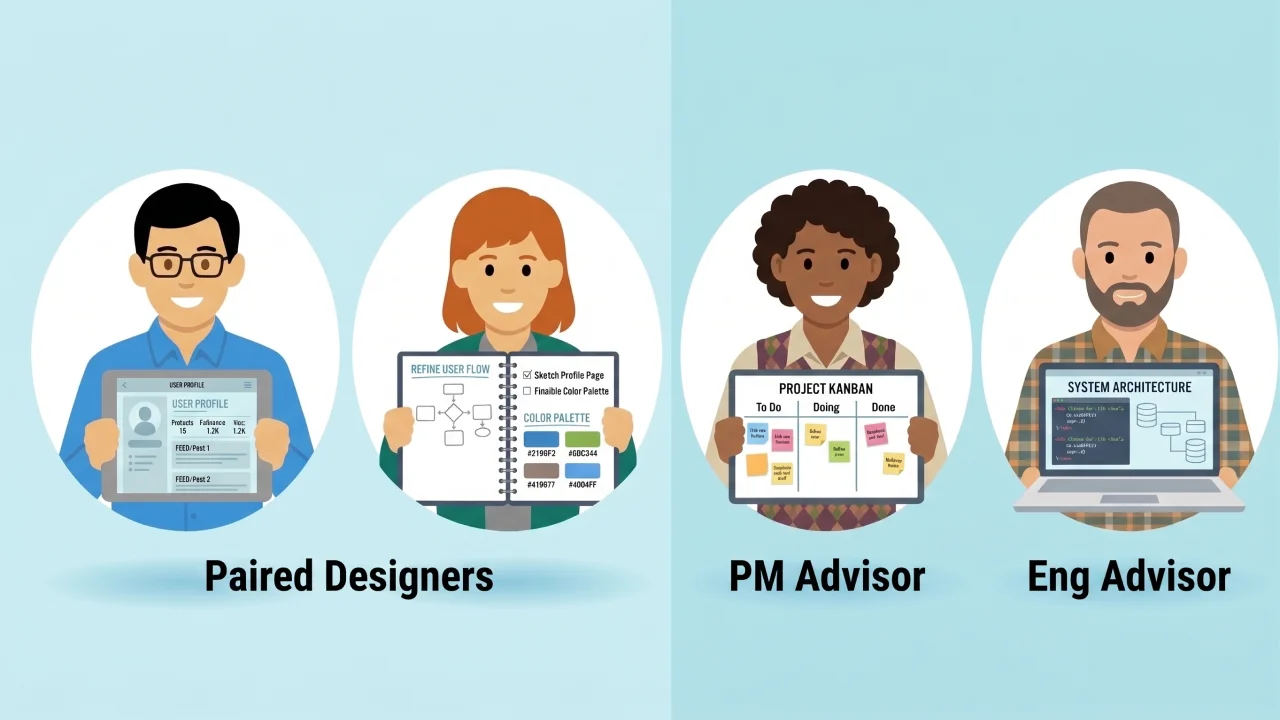
- Two paired designers as core team
- PM and Engineering embedded as collaborators
Three-Week Sprint
- Research, synthesis, and design in a fixed cadence
- Regular executive touchpoints to maintain alignment

Clear End States
- Approve: Move to a product team.
- Reject: Learn and stop
- Continue: Run another Idea Dash
First Idea Dash: Manager 1:1

The Manager 1:1 is a core weekly sales ritual where managers scrutinize pipeline health, coach performance, and evaluate a rep’s ability to hit quota.
Why This Was Chosen
- The GM of Sales Cloud collected consistent executive feedback on the need to support the Manager 1:1
- Current Sales Cloud forecast capabilities were considered to be underperforming in the market
What Was Explored
- Visibility into pipeline health and rep performance
- How managers coach and forecast in real time
Design Concepts
After desk research and agreement on the design brief, we generated two separate concepts around the identified problem:
1. Simple & Directed
Minimal UI using conversational natural language
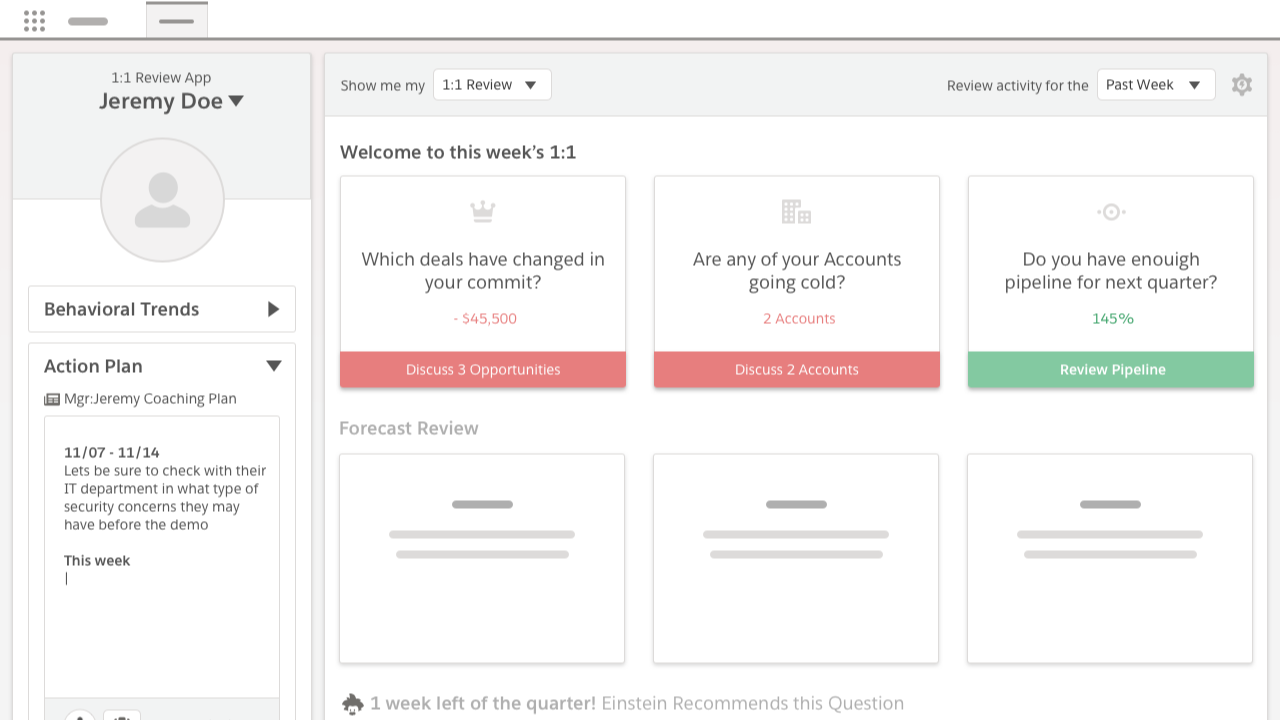
Directed Questions Guide the Manager 1:1
This concept led with minimalist UI that focused the conversation to answer specific questions relevant to a 1:1
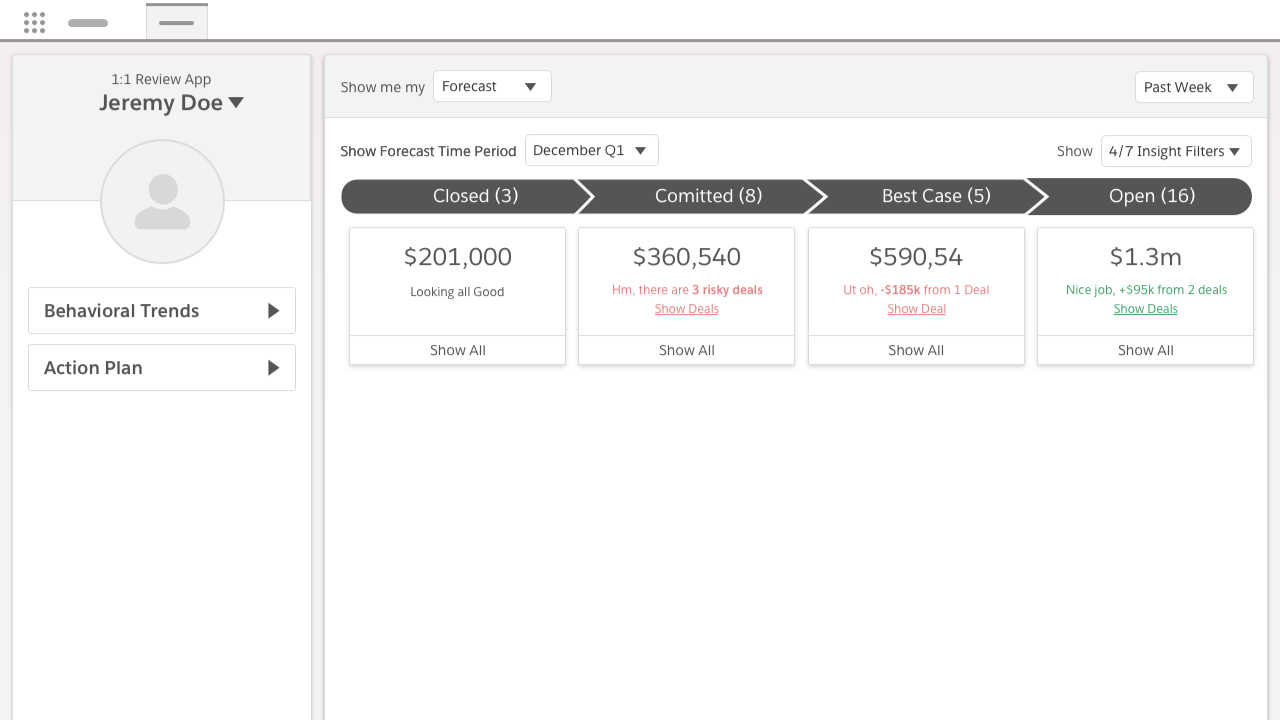
Rollup Numbers
When looking at a sales rep’s book of business, the experience focused on roll-ups of where the deals were in their progress for the current relevant time period rather than displaying individual deals
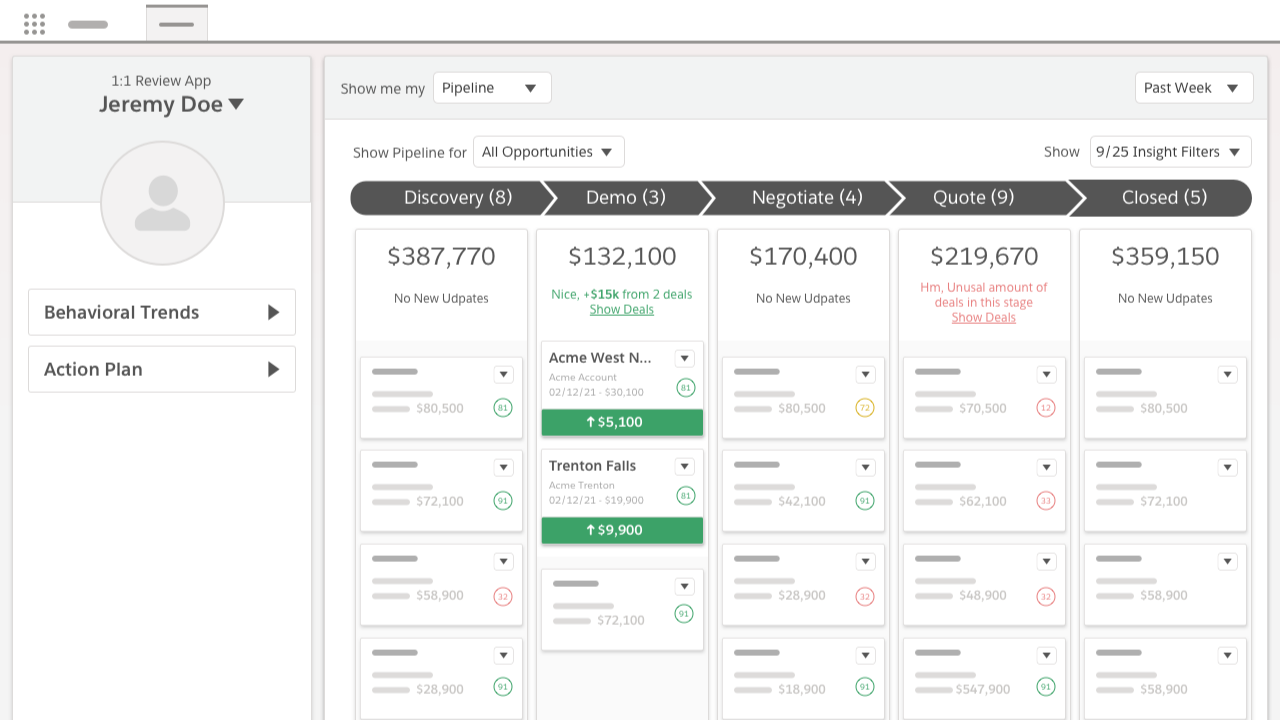
All Opportunities Show Signals
Showing the rep’s entire list of deals in progress included natural language commentary and insights
2. Higher Signal to Noise
Data-dense, with visual weight on what is important
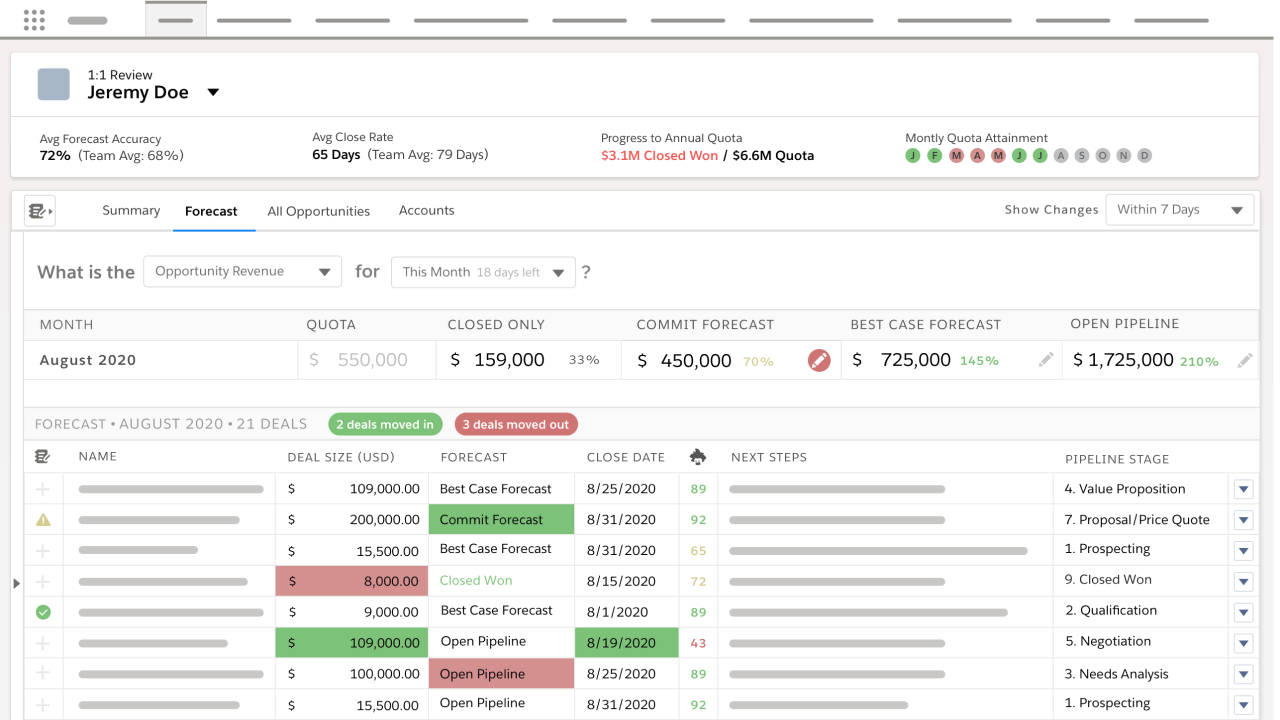
Higher Data Density with Clear Visual Cues
At-a-glance design system that allows the manager to see all of a rep’s deals and be able to understand what has changed since their last check-in
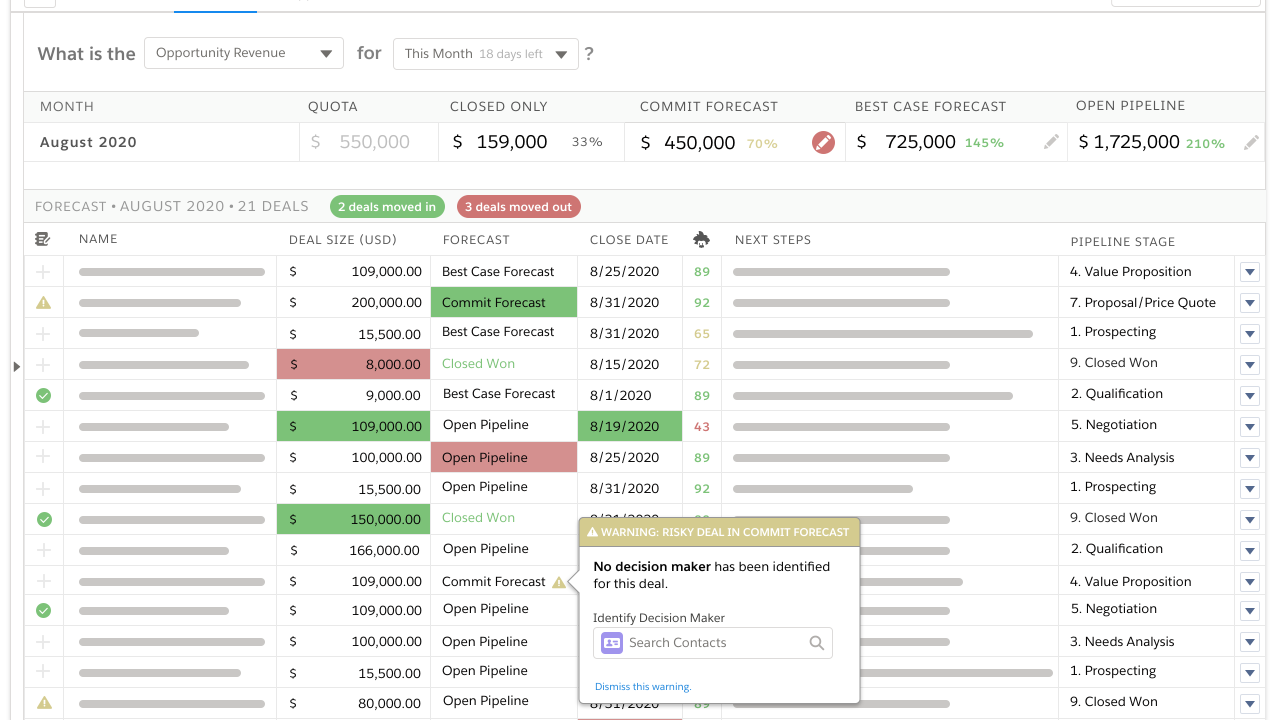
Deeper Understanding
CTA signals invite the user to reveal additional information about what issues may need immediate attention
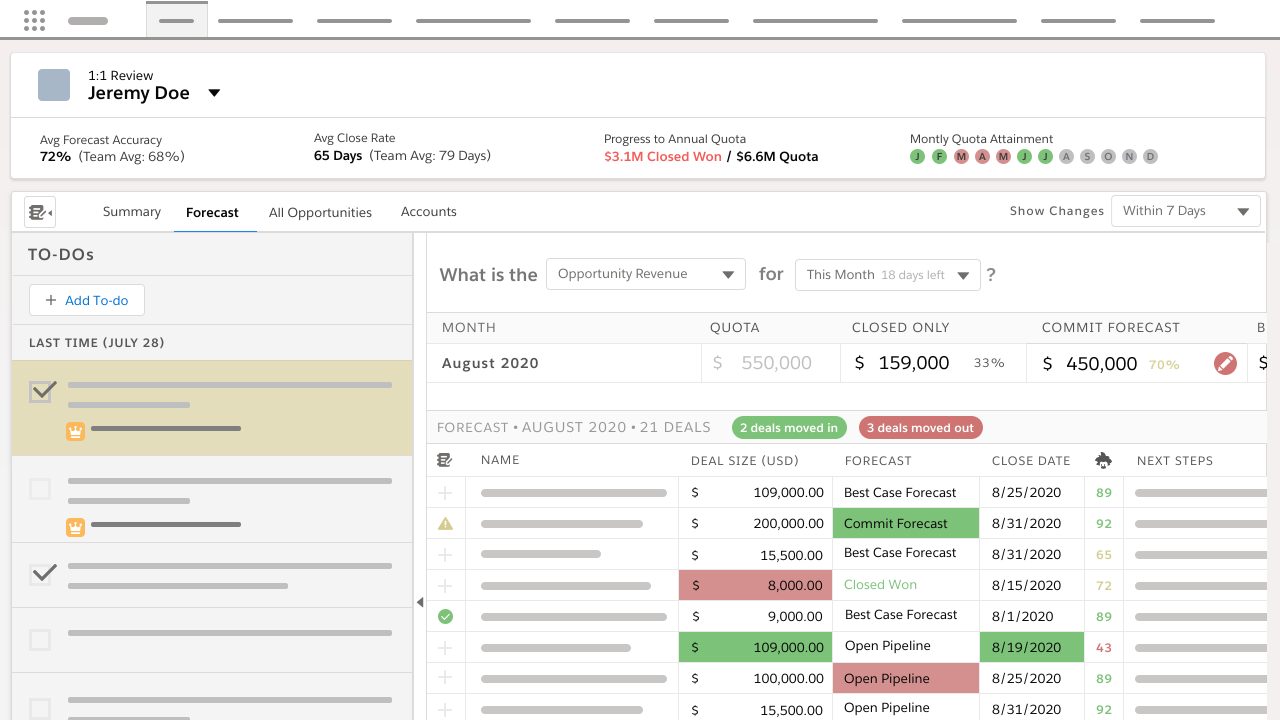
Easy Documentation
Accountability for the rep is measured in easily accessible documentation about what the manager expects to be completed before their next 1:1
Dash Results
Presentation & Prototypes
Deck and prototype presented to GM and exec team
Decision: Continue
Run a second Idea Dash with qualitative validation
Second Idea Dash: Research
Taking the two concepts, we moved into a quick research sprint to gain insight and confidence around the product.
Research Approach
- Qualitative interviews with 10 subjects ranging from VPs to Senior Managers
- Lightweight competitive analysis
- Rapid synthesis workshops
Top Line Interview Results
100%
Preference for Higher Signal concept
Universal design for the flexibility to view all the data with a layer of signal feedback,
80%
Documentation Desired
8 of 10 participants requested that follow-up notes and action item documentation be included.
10 of 10
Much improved solution
Universally, participants responded that the concept seemed like a natural progression from the existing solution.
Design Principles
From the research, five experience themes emerged that users want this new experience to exemplify:
Speak in Human Terms
Many managers and reps are not power users of applications. Those interviewed using other products stated their preference for reports and controls that are presented using natural, accessible language.
Be as Fast as the Conversation
Users choose the solution that meets their needs for speed and efficiency. Points of friction are not tolerated, and users will abandon products to find faster workarounds.
Show the Action
Managers know what types of information they want to discuss but they need help finding it, such as any major changes to deals, the kinds of activities the reps are performing, and whether or not they are completing agreed-upon tasks from the last 1:1.
Make Accountability Easy
Every manager we spoke with agreed that documenting conversations and creating trackable to-dos was a clear win.
“Data Display” Does Not Always Mean Text
Feedback from research indicates that users respond well to Clari and other products’ use of visual treatments to convey data.
Dash Results
The executive team approved the Higher Signal concept and moved it to a product team.
The result was the Pipeline Inspection feature added to all Sales Cloud instances.
Pipeline Inspection launched for Sales Cloud
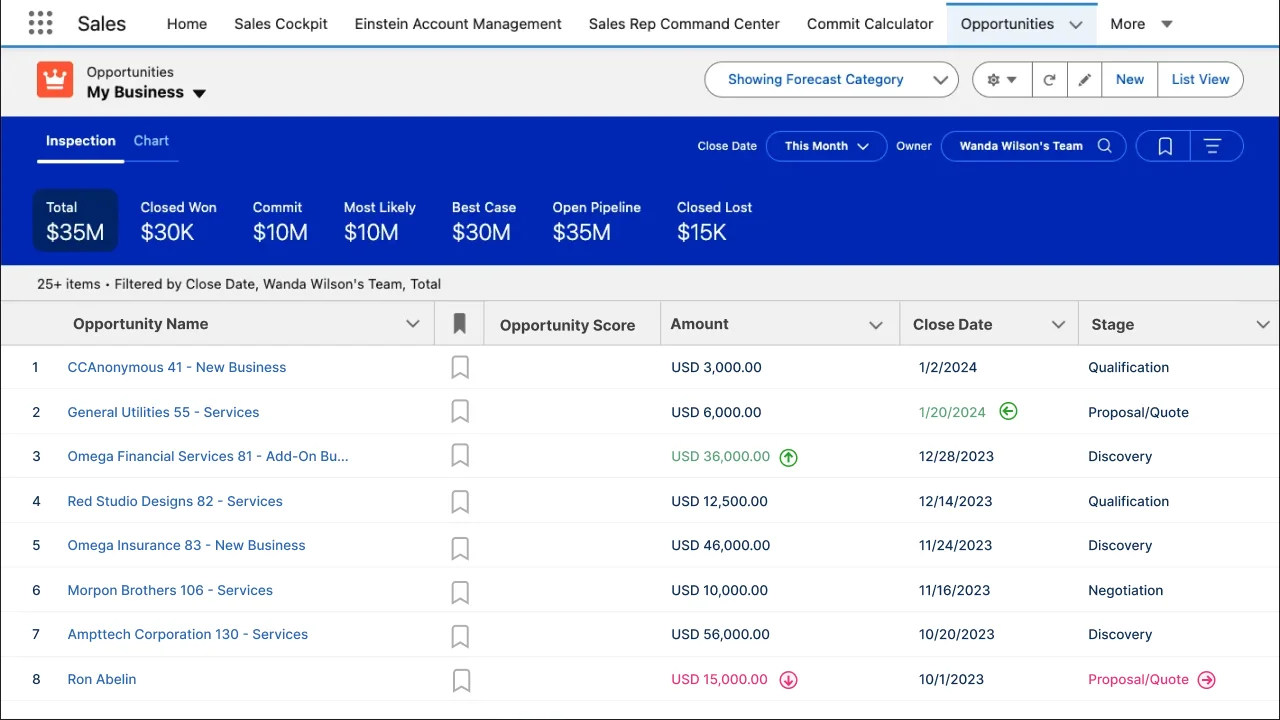
Extension of the Design System
Accommodating in-line editing and visual prompts

Deeper Information
Popovers reveal what has changed since the last viewing
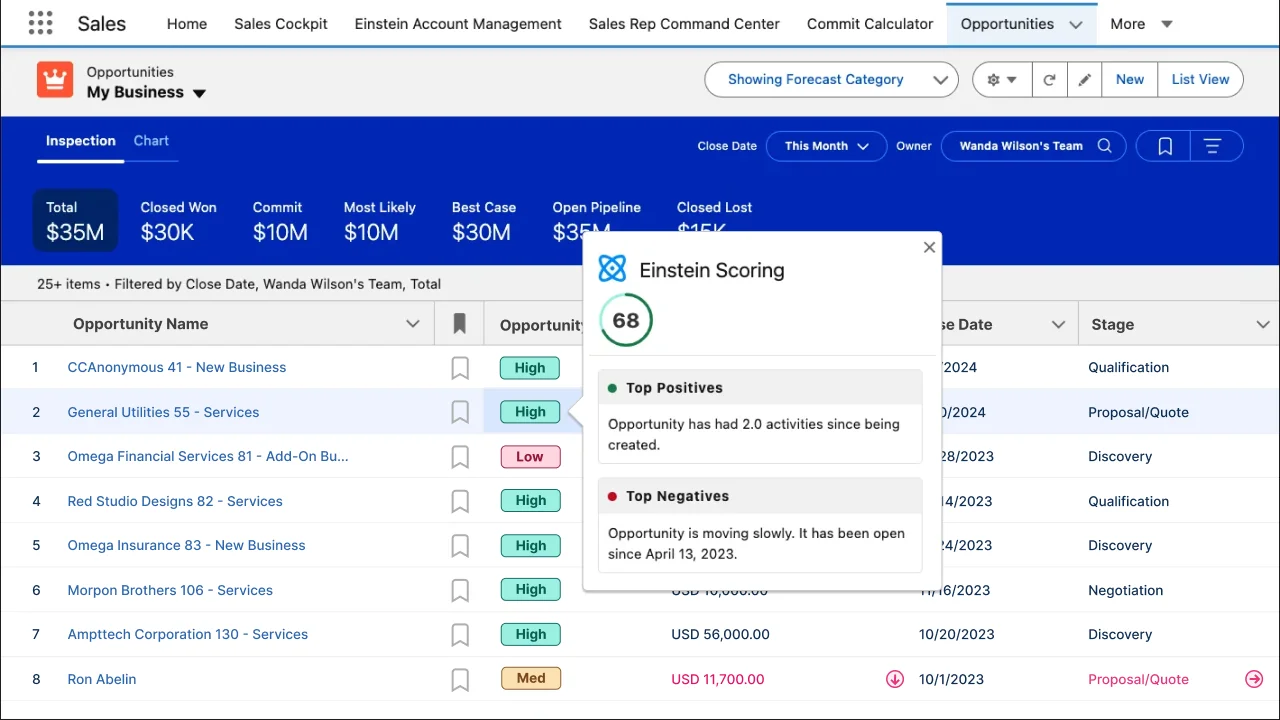
Opportunity Scores
Integration of opportunity scores for more informed decisions
Impact
50%
Faster Start
An average of one month saved between leadership approval and the start of development, after the time spent on the Idea Dash itself
40%
Increase
In new features that met or exceeded goals